
Market Developments and Growth Expectations in the Beverage Sector in Spain and Portugal
Indice
- Stable market environment with growth expectations in the alcohol-free beverages segment
- Per-capita volume of non-alcoholic beverages and beer at a high level
- BrauBeviale 2026 brings together solutions for a broad beverage portfolio
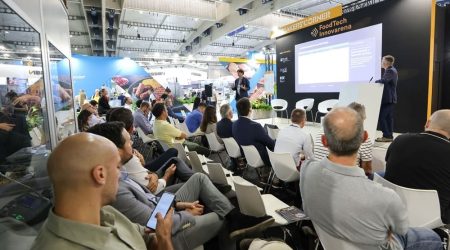
Beverage markets are currently developing in two directions at the same time: driven by consumers’ desire for self-optimisation, energy drinks, functional beverages and alcohol-free concepts are continuing to grow. At the same time, the need for community, atmosphere and shared experiences remains high – particularly in economically and socially challenging times. The “BrauBeviale meets Europe” tour addresses the background to these developments and will stop in Madrid on 8 July 2026.
The markets in Spain and Portugal are showing stable tendencies: consumption of alcoholic beverages is growing in Spain and Portugal. By comparison, the non-alcoholic beverage market remains largely stable overall, with individual shifts between segments.
Spain in Detail – Alcohol-Free Beverages
Looking at non-alcoholic beverages as a whole, Spain shows a similarly stable picture to the European average. The total volume of alcohol-free beverages in Spain stood at 112 litres per capita in 2025, compared with a European average of 179 litres.
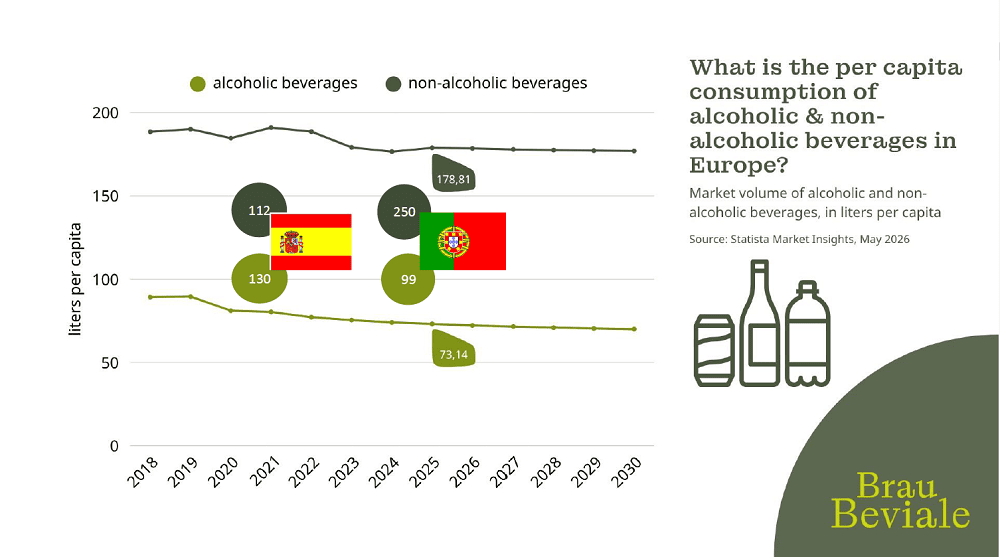
According to data from Statista Market Insights, both the European and Spanish averages remain largely stable in the soft drinks category, while slight growth is expected in the mineral water segment in Spain. In 2025, the figure stood at 70 litres per capita; by 2030, a slight increase of around 2 per cent is expected.
Parallels with the European average can also be seen in the outlook for energy drinks: compared with a European average of 2.95 litres per capita, Spain is at a volume of almost 6 litres per capita and can expect market growth of around 8 per cent by 2030.
For RTD beverages, the overall European market is expected to grow by 7 per cent, based on a per-capita volume of 1.28 litres. Spain stands at an average of 0.34 litres per capita in 2025 – a figure that, according to growth forecasts, is expected to rise by around 8 per cent by 2030, albeit from this low level.
Portugal in Detail – Alcohol-Free Beverages
The total volume of alcohol-free beverages in Europe averages around 179 litres per capita in 2025; for Portugal, this figure is estimated at 253 litres per capita and, according to data from Statista Market Insights, is expected to remain roughly at this level until 2030.
Growth within this sector is being driven by shifts in preferences, for example in the energy drinks segment: with a market volume of 4.7 litres per capita, Portugal is above the European average of 2.95 litres per capita and can expect market growth of around 10 per cent by 2030.
In line with growth in the RTD beverages category in Europe, the Portuguese market is also expected to grow by 2030: average per-capita consumption there stands at 1.45 litres in 2025, compared with the European average of 1.28 litres. Growth of around 8 per cent is forecast for this segment.
Beer as a “social lubricant”
Across Europe, alcohol-free beer offerings are gaining importance. The European average stands at 2.7 litres per capita. By contrast, consumption in Spain is estimated at 4.9 litres per capita, which is significantly higher than the European average. Per capita consumption of non-alcoholic beer in Portugal stood at 1.3 litres in 2025. Growth in this beer category is evident in both countries: per capita consumption is expected to rise by 5 per cent in Spain and 10 per cent in Portugal.
Alcoholic beer remains firmly established in both markets. In 2025, per capita consumption stood at around 89 litres in Spain and 40 litres in Portugal. By comparison, the European average was just around 47 litres in 2025 and is forecast to fall steadily to around 45 litres by 2030. Whilst a downward trend is emerging for Europe as a whole, Spain is following a contrasting course. Per capita consumption there is expected to grow by around 7 per cent by 2030. Growth of 11 per cent is estimated for Portugal.
Analyses by the rheingold Institute indicate that these developments go beyond a short-term lifestyle trend. In an increasingly uncertain and difficult-to-control world, many people are focusing more strongly on what they can influence themselves: health, performance, flexibility and personal stability. The institute describes this development as an attempt to remain as stable and capable of acting as possible within a complex reality. An aspiration that is also changing the beverage industry.
At the same time, the need for community and a sense of security is growing. This is precisely why beverage segments such as beer remain relevant. Beer stands for something familiar – craftsmanship, origin and tradition. In an uncertain world shaped by technological, social and economic disruption, this sense of groundedness is becoming increasingly important once again.
“Beer brands are ideally suited to creating places, atmospheres and moods in which a sense of community can be experienced and placed at the centre of the occasion,” explained institute expert Paul Bremer during the first stop of the BrauBeviale meets Europe tour in Copenhagen. “Beer brands and gastronomy should offer places that convey a sense of togetherness.”
Where the beverage industry finds answers
“We are currently witnessing some very exciting developments in the market,” said Markus Kosak, Executive Director at YONTEX GmbH & Co. KG. “Consumers want to remain productive and capable – while at the same time continuing to enjoy shared experiences. This means that our established and traditional beverage segments, such as beer, can continue to strengthen their role in the market. At the same time, the desire for self-optimisation is creating new opportunities for beverage manufacturers. Our exhibitors understand this and are presenting solutions for all the requirements facing the industry in Europe.”
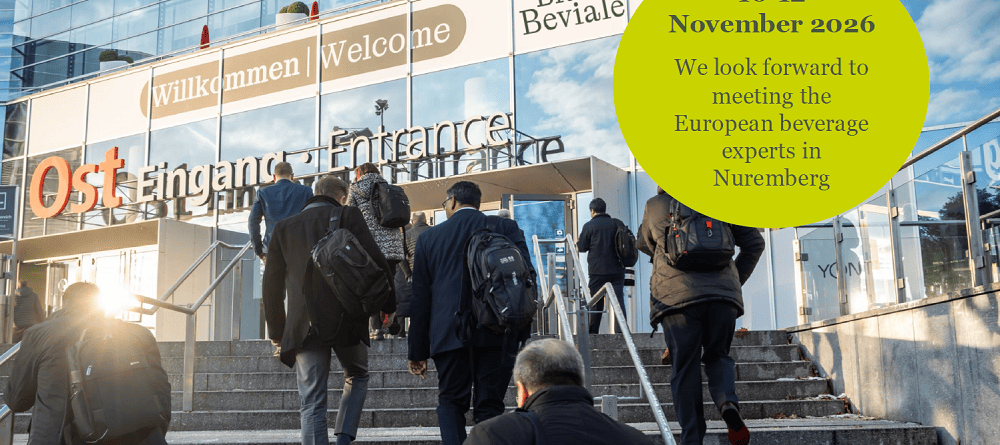
The entire supporting programme of BrauBeviale 2026, taking place in Nuremberg from 10 to 12 November 2026, is geared towards the challenges facing the European beverage industry. Topics covered in the programme include changing consumption habits, alcohol-free concepts, flexible production requirements and the question of how manufacturers can economically serve different consumption occasions. On the Main Stage in Hall 9, beverage expert Charles Nouwen from Peer to Beer will discuss the role of beer between tradition, community and changing consumption habits.
It is already worth regularly visiting the BrauBeviale website: the exhibitor and product database is online, further information about the supporting programme is continuously being added, and the ticket shop for visitors is also open.